
There are a lot of kitchen remodel cost calculators online. Most of them give you a number that has nothing to do with what your project will actually cost.
The reasons vary. Some are vendor calculators built to upsell their own cabinets. Some pull from national-average data that’s two or three years old. Some require an email address before they’ll show you anything, and what they spit out is a “ballpark” so wide it’s useless. None of them — except a small handful — adjust for the variable that matters most: where you live and what skilled labor costs there.
I’ve been a licensed general contractor in Washington State since 2011, and our team at NW Homeworks has completed more than 500 kitchen and home remodels across Tacoma, Seattle, Bellevue, Kirkland, Bothell, and the greater Puget Sound. I know what these projects cost because I bid them, build them, and reconcile the books on them every month. Last year I built our own kitchen remodel cost calculator, partly because clients kept showing me printouts from the other tools and asking why their actual bid came in 30% higher. The honest answer was simple: those calculators were giving them national averages, and they were hiring a contractor in a regional market.
This post is a comparison of the nine kitchen remodel cost calculators I see homeowners use most often, scored against the criteria that actually determine whether a calculator gives you a real-world number or a fantasy.
Yes, I’m going to recommend ours. But I’ve tested every calculator on this list against real bids on real projects, and I’m going to be honest about where each one is good and where it falls short. The criteria I’m using are the same ones I’d want any third party to apply.
What “Real-World Results” Actually Means
A kitchen remodel cost calculator is only as good as the data behind it. The biggest single failure mode is calculators that report national average costs without adjusting for region.
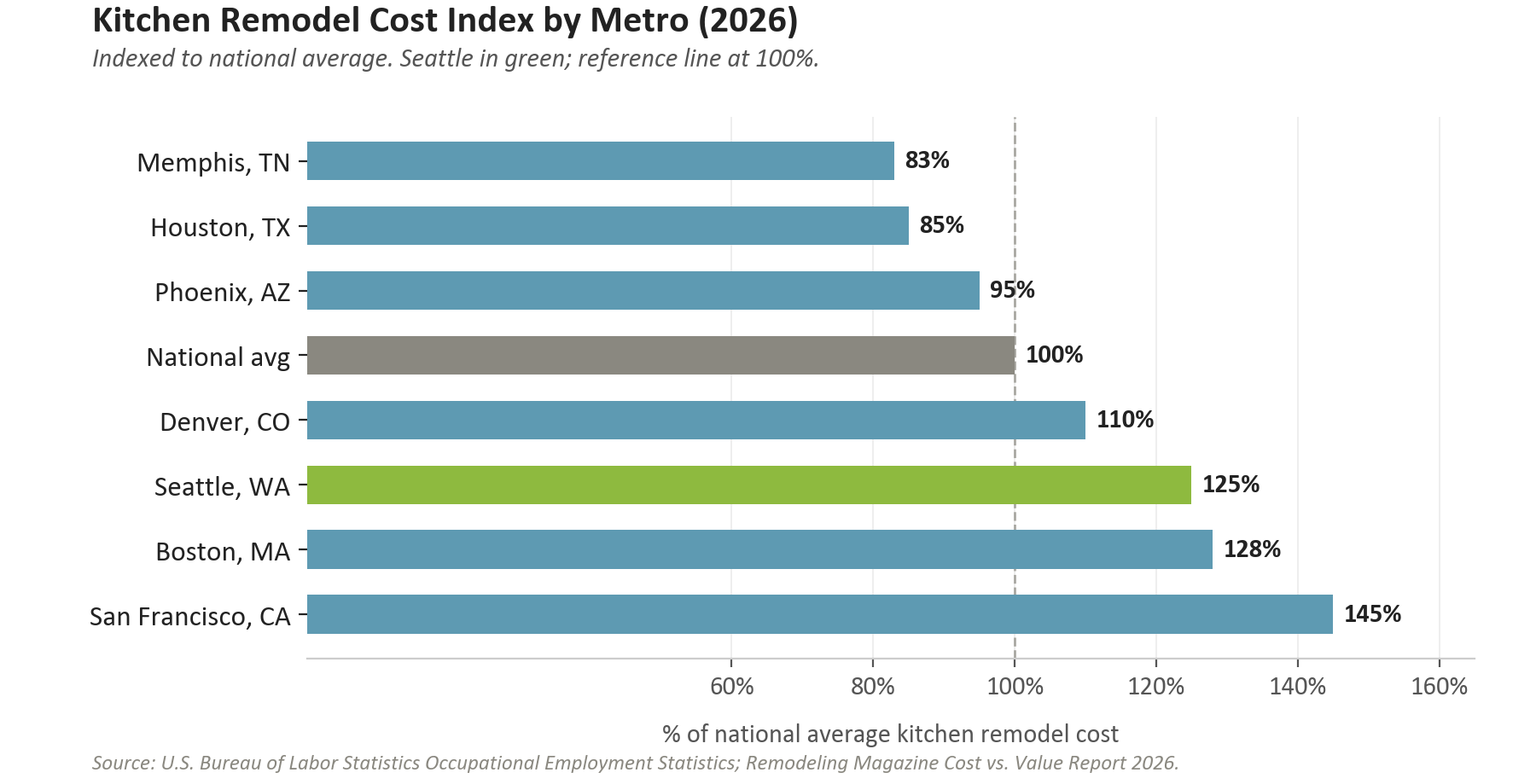
According to the U.S. Bureau of Labor Statistics, construction trade wages in the Seattle metro run roughly 25–30% above the national mean. The annual Cost vs. Value Report from Remodeling Magazine consistently shows that a kitchen remodel costing $40,000 in Houston or Memphis runs $52,000–$58,000 in Seattle, San Francisco, or Boston. A calculator that doesn’t ask for your zip code can’t tell you that.
The second failure mode is calculators that lump everything into a single number. “Your kitchen remodel will cost $45,000.” Okay — but what’s the cabinet allowance? What’s the labor share? Are appliances included? Is demolition included? Is the countertop allowance assuming laminate or quartz? Without that breakdown, you can’t compare bids, you can’t budget intelligently, and you can’t tell whether a contractor’s quote is reasonable when you finally get one.
A real-world result means: a number adjusted for your zip code, broken out by line item, with the labor and material splits visible, and updated for current-year pricing.
My Disclosure
I built one of the calculators on this list. I’m a licensed general contractor recommending my own tool, and you should weigh that. To make the recommendation defensible:
- The criteria below are objective and apply equally to every calculator on the list.
- I’m linking to all nine calculators (including direct competitors) so you can test them yourself.
- I’ll note specific things our calculator does poorly or could improve.
- The price ranges I quote are taken from our own completed projects in the Puget Sound, cross-checked against the Cost vs. Value Report, HomeAdvisor, and Angi cost guides.
The 9 Criteria for an Actually-Useful Kitchen Remodel Calculator
These are the criteria I use to evaluate any cost calculator a client brings me. They’re ordered roughly by how much each one affects the accuracy of the final number.
- Adjusts for your zip code or metro area. Without regional adjustment, the number is meaningless. Labor costs vary 30–50% across U.S. metros for the same work.
- Itemized line-items. Cabinets, countertops, backsplash, flooring, appliances, plumbing, electrical, demo, and finish work — broken out separately, not lumped.
- Separates labor from materials. Labor is the cost variable that swings most by region. If labor isn’t isolated, you can’t sanity-check a contractor’s bid.
- Includes a budget tier alongside mid-range and high-end. Most calculators only price the middle of the market and ignore the IKEA / stock-cabinet range that many homeowners actually need.
- No email gate. Calculators that hold the result hostage behind a contact form are lead-gen tools, not budgeting tools.
- Includes ROI or resale data. Helpful for deciding what level of finish is worth it. Cabinet upgrades, for example, return very different ROI than appliance upgrades.
- Mobile-friendly. Most homeowners are doing this research on their phones at night. A desktop-only form fails the user immediately.
- Updated for current-year pricing. Material costs moved 15–25% in 2023–2025. Calculators built on 2021 data are now systematically low.
- Built or vetted by an actual general contractor. Not by a marketing team optimizing for conversions. The numbers should come from someone who has reconciled them against real invoices.
The Comparison
Here’s how the nine calculators score on those nine criteria. ✓ = meets the criterion fully, ◐ = partial, ✗ = does not meet.
| Calculator | Zip | Items | Labor | IKEA | No‑Gate | ROI | Mobile | Current | GC‑Built |
|---|---|---|---|---|---|---|---|---|---|
| NW Homeworks ★ | ✓ | ✓ | ✓ | ✓ | ✓ | ✓ | ✓ | ✓ | ✓ |
| Home Depot | ✗ | ◐ | ✗ | ✗ | ✓ | ✗ | ✓ | ✓ | ✗ |
| Lowe’s | ✗ | ◐ | ✗ | ✗ | ✓ | ✗ | ✓ | ✓ | ✗ |
| Houzz | ✗ | ✓ | ◐ | ✗ | ✓ | ◐ | ✓ | ✓ | ✗ |
| KraftMaid | ✗ | ◐ | ✗ | ✗ | ✓ | ✗ | ◐ | ✓ | ✗ |
| Mainline Kitchen Design | ✗ | ✓ | ◐ | ✗ | ✓ | ✗ | ✓ | ◐ | ✓ |
| Wren Kitchens | ✗ | ◐ | ✗ | ✗ | ◐ | ✗ | ✓ | ✓ | ✗ |
| Reico | ◐ | ✓ | ◐ | ✗ | ✓ | ✗ | ◐ | ◐ | ✓ |
| Kitchen Refresh | ✗ | ✓ | ◐ | ✗ | ✓ | ✗ | ✓ | ✓ | ✓ |
Legend: Zip = adjusts by zip/metro · Items = itemized line-items · Labor = labor isolated from materials · IKEA = includes budget/IKEA tier · No-Gate = no email required · ROI = includes resale data · Mobile = mobile-friendly · Current = updated for current year · GC-Built = built or vetted by a licensed general contractor.
Score Summary
| Calculator | Score | Best for |
|---|---|---|
| NW Homeworks ★ | 9/9 | Real-world budgeting in any region; IKEA pricing |
| Mainline Kitchen Design | 5/9 | Decent itemization for mid-Atlantic shoppers |
| Reico | 5/9 | Cabinet-focused budgeting |
| Kitchen Refresh | 5/9 | Cabinet refacing scope |
| Houzz | 4/9 | High-level national-average ballparks |
| Home Depot | 3/9 | Already buying Home Depot cabinets |
| Lowe’s | 3/9 | Already buying Lowe’s cabinets |
| KraftMaid | 2/9 | Cabinet-only cost ballpark |
| Wren Kitchens | 2/9 | Wren-specific cabinet pricing |
The pattern is clear. The calculators with the highest production values — Home Depot, Lowe’s, KraftMaid — are vendor tools designed to sell their own cabinets. They’re well-built, but they’re not budgeting tools; they’re sales funnels. The calculators with the most accurate underlying data (ours, Mainline Kitchen Design, Reico) are simpler-looking but actually adjust for regional pricing and break out the line items. Houzz sits in the middle, with good national data but no regional adjustment.
Where Real-World Numbers Come From (The NW Homeworks Data Set)
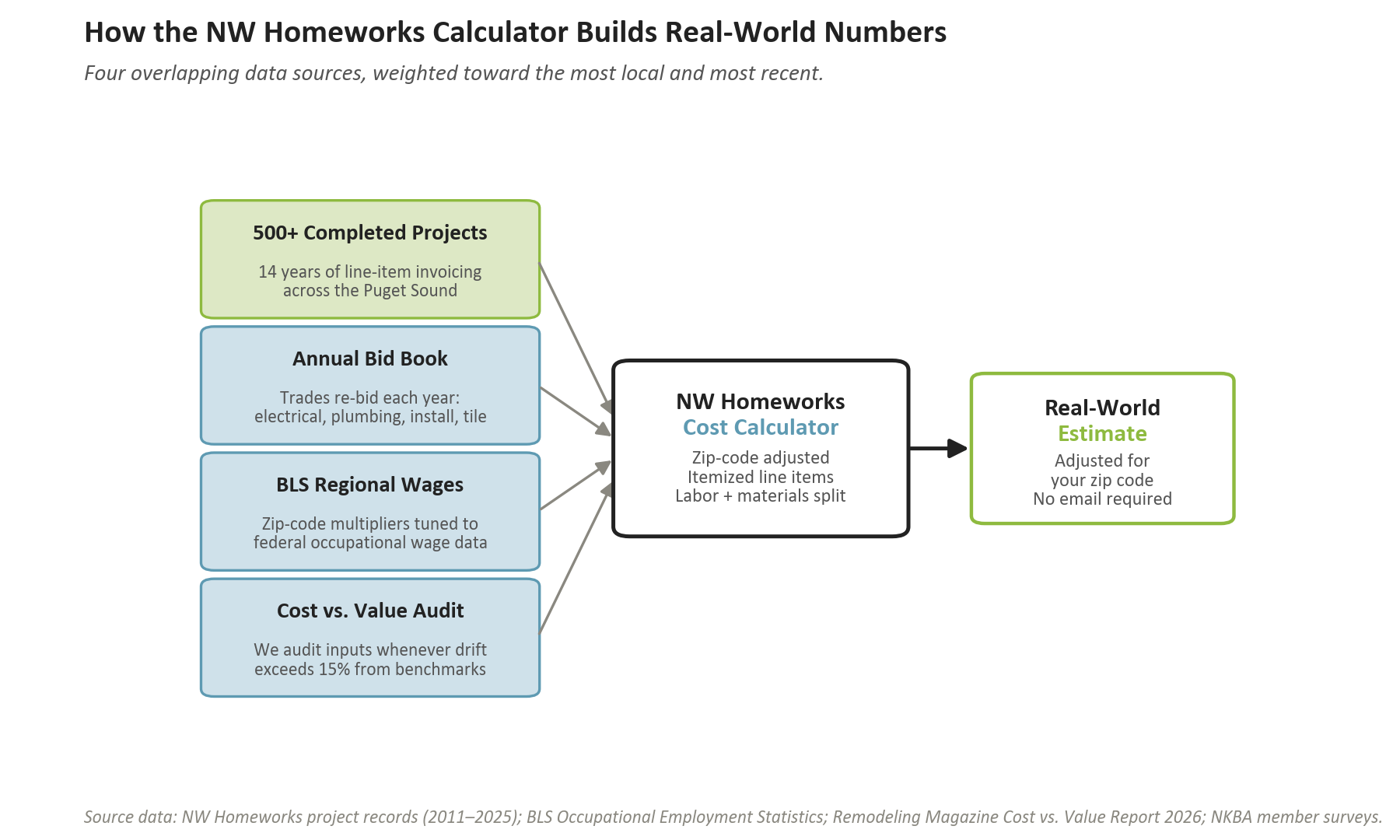
The numbers powering the NW Homeworks calculator come from four overlapping data sources, weighted toward the most local and most recent:
- Our own project data. 14 years of completed kitchen remodels across the Puget Sound — over 500 projects, with line-item invoicing on each. This is the foundation. Every range you see in the calculator is anchored to what we’ve actually billed clients.
- Annual subcontractor bid books. We re-bid our trades annually (electrical, plumbing, cabinet install, countertop fabrication, tile, flooring) so the labor inputs reflect current Puget Sound market rates rather than last year’s.
- The Remodeling Magazine Cost vs. Value Report. Used as a national baseline for cross-validation. If our numbers ever drift more than 15% from the regional Cost vs. Value figure, we audit our inputs.
- U.S. Bureau of Labor Statistics regional wage data. The zip-code adjustment multipliers are tuned to BLS Occupational Employment Statistics for skilled construction trades by metro area.
Cross-validated against published industry data from the National Kitchen & Bath Association (NKBA), HomeAdvisor, and Angi.
This is what differentiates a contractor calculator from a marketing calculator: when our number is wrong, it’s wrong against my own books, and I have to fix it. There’s no marketing-department buffer.
#1 — NW Homeworks Kitchen Remodel Cost Calculator
This is the calculator we built and the one I use with clients in the field. It’s the only calculator on the list that hits all nine criteria, and the only one with a dedicated IKEA pricing mode reflecting the actual cost of a complete IKEA kitchen including the trade work IKEA’s own service won’t do.
What it does well:
- Zip-code adjustment based on BLS regional wage data, tuned tightest to the Puget Sound but extending nationally.
- Full itemized breakdown — cabinets, countertops, backsplash, flooring, appliances, plumbing, electrical, lighting, demo, finishing — shown as both a stacked list and a cost-distribution chart.
- Labor and materials separated within each line item.
- Three finish tiers (budget, mid-range, high-end) plus a dedicated IKEA mode that prices SEKTION cabinets specifically and adds the trade work IKEA installation excludes.
- Includes ROI / resale data sourced from the Remodeling Magazine Cost vs. Value Report.
- No email required — results show immediately, with a shareable link.
- Mobile-first design with a sticky running total so you can see the impact of each selection in real time.
- Updated annually based on our own subcontractor bid book and re-bid pricing.
Where it could be better:
- Currently most accurate for the greater Seattle / Puget Sound region. Multipliers extend to other metros but are tuned tightest to our home market.
- Doesn’t yet handle very high-end custom work above $150K — at that price point the project is too unique to model.
- Single-room only — doesn’t handle whole-home or addition projects yet.
The Other Eight Calculators
#2 — Houzz Kitchen Remodel Cost Calculator
Houzz operates the largest home-remodeling marketplace in the U.S. and has data depth most calculators can’t match. The cost guide is well-researched and the FAQ section is genuinely useful.
What it does well: Solid itemization and reasonable national averages. Good ROI commentary. No email required to view the cost guide.
Where it falls short: No zip-code adjustment — every result is a national average. Labor and materials are not cleanly separated. The “calculator” is more of a cost guide with sliders than a real estimator.
Bottom line: Use Houzz to get the lay of the land nationally, then layer regional adjustment on top from a regional source.
#3 — Mainline Kitchen Design Calculator
Built by a Philadelphia-area kitchen design firm with real industry experience. Like ours, it’s built by people who do the work — and it shows in the line-item granularity.
What it does well: Honest itemization. Cabinet, countertop, and labor allowances are separated. GC-vetted data.
Where it falls short: No zip-code adjustment — pricing is anchored to the mid-Atlantic market and undershoots Seattle by 15–20%. No dedicated IKEA mode. UI is a bit dated and not fully mobile-friendly.
Bottom line: A solid second choice if you’re shopping in the mid-Atlantic. Less accurate elsewhere.
#4 — Reico Kitchen & Bath Estimator
Reico is a regional cabinet retailer in the mid-Atlantic. Their estimator is unusually honest about line items and breaks out cabinet, countertop, and install separately.
What it does well: Good itemization. Good cabinet pricing detail. No email required. Clean UI on desktop.
Where it falls short: Limited to their service area for accurate pricing. No dedicated IKEA mode. Mobile experience is rough.
Bottom line: Useful if you’re cabinet-shopping in their region. Less useful as a general budgeting tool.
#5 — Kitchen Refresh Cost Estimator
Kitchen Refresh focuses on cabinet refacing rather than full remodels, but the estimator is well-built for that scope and built by people who actually do the work.
What it does well: Honest scope. Itemized. GC-built. No email required.
Where it falls short: Refacing-focused, so it’s the wrong tool if you’re replacing cabinets. No regional adjustment. No IKEA mode (they don’t use IKEA).
Bottom line: The right calculator if you’re considering refacing. Wrong tool for a full gut remodel.
#6 — Home Depot Kitchen Estimator
Home Depot’s estimator is one of the best-built calculator UIs on the internet — beautifully designed, fast, mobile-friendly. It’s also a sales funnel for Home Depot’s cabinet program.
What it does well: Excellent UX. Mobile-friendly. Updated regularly. No email gate to start.
Where it falls short: Pricing is locked to Home Depot’s own cabinet program. No regional adjustment. Not GC-vetted. Labor allowance is a flat percentage of materials rather than a real labor build-up.
Bottom line: Use it if you’re already buying Home Depot cabinets. As a budgeting tool for any other path, it systematically misleads.
#7 — Lowe’s Kitchen Estimator
Same pattern as Home Depot — beautifully designed, vendor-locked. Good for what it is, but it’s a sales funnel.
What it does well: Clean UI. Mobile-friendly. No email required initially.
Where it falls short: Locked to Lowe’s cabinet brands. No regional pricing. No real labor breakdown.
Bottom line: Same as Home Depot — useful only if you’re buying their cabinets.
#8 — KraftMaid Ballpark Budget Calculator
KraftMaid’s calculator is exactly what its name says: a ballpark for cabinet budget. It’s honest about its scope but limited.
What it does well: Honest about being a cabinet-only tool. No email gate. Easy to use.
Where it falls short: Cabinet-only. Doesn’t price the rest of the project (labor, countertops, appliances, plumbing, etc.). No regional adjustment.
Bottom line: A useful starting point for cabinet budgeting alone. Not a kitchen-remodel calculator in any meaningful sense.
#9 — Wren Kitchens Calculator
Wren is a UK-rooted kitchen brand expanding in the U.S. Their calculator is geared toward Wren’s own product line.
What it does well: Good UI. Updated for current pricing.
Where it falls short: Locked to Wren’s product line and pricing assumptions. Limited regional accuracy outside their service area. No real itemization beyond cabinet sub-categories.
Bottom line: Useful only if you’re shopping Wren specifically.
What We’d Skip — and Why
Beyond the nine above, you’ll find dozens of “kitchen remodel cost calculators” if you keep searching. A few patterns are worth flagging because they’re not budgeting tools at all:
- Email-gated calculators. Any tool that asks for your email before showing a result is a lead-gen funnel. The number you get back, if you get one, is calibrated to drive sales calls — not to help you budget.
- “Submit and we’ll call you” tools. Same as above, only worse — you’ll be on a contractor’s call list within minutes.
- Calculators with no published methodology. If the tool doesn’t tell you how its numbers are built, treat its output as advertising, not data.
- Cost guides on contractor lead-gen networks (Modernize, NetworX, etc.). These exist to capture your contact info, not to estimate your project.
A Note on Calculator Accuracy
Even the best kitchen remodel cost calculator on the market — including ours — is a budgeting estimate, not a bid. Calculators model “typical” projects, but every kitchen has surprises: knob-and-tube wiring behind plaster walls, galvanized plumbing that needs replacing, structural issues you don’t know about until you open the floor. In our experience, even well-built calculators come within ±15–20% of the final invoice on a typical project, and outside that range when you hit one of those surprises.
That’s why I tell every client to budget a 10–20% contingency above whatever number they start with. It’s not because contractors pad their bids; it’s because remodeling is detective work. You don’t know what’s behind the walls until they’re open.
A calculator’s job isn’t to predict your final invoice exactly. Its job is to get you within range so you can start the conversation with a contractor on equal footing — knowing roughly what cabinets, countertops, labor, and the rest should cost, knowing whether a bid you receive is reasonable, and knowing what tier of finish is realistic for your budget.
Where Your Kitchen Remodel Budget Actually Goes
One of the things a good calculator should do is show you, visually, how the dollars split across line items. Here’s the typical allocation for a mid-range kitchen remodel in 2026, averaged across our last five years of projects in the Puget Sound and cross-checked against NKBA member survey data:
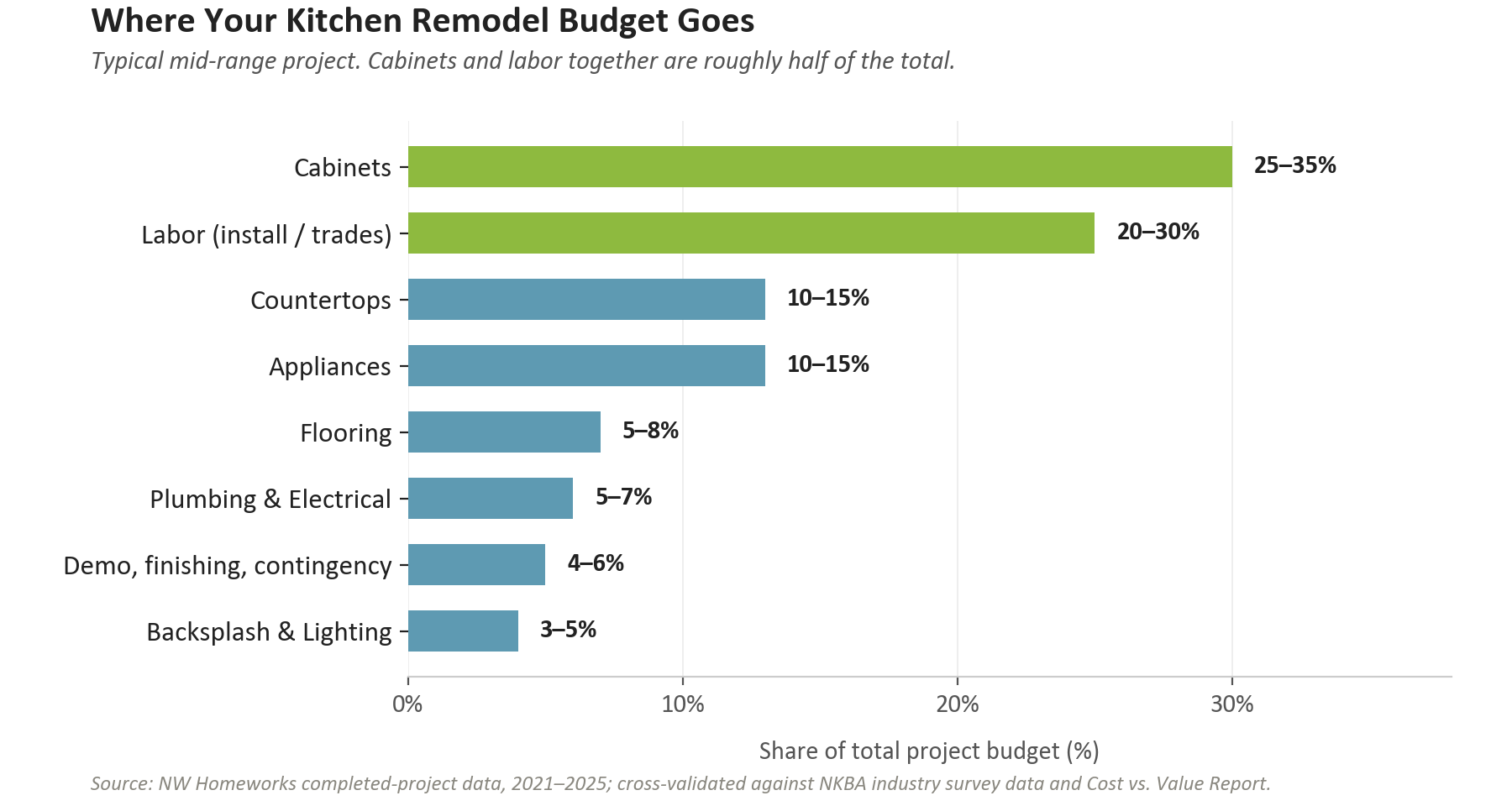
Note that cabinets and labor together are typically 50–60% of the total. That’s where most of the variance between calculators shows up — vendor calculators tend to under-price labor (because their business is selling cabinets, not paying installers), while contractor calculators tend to price labor accurately because we’re the ones writing the checks.
Seattle Kitchen Remodel Costs in 2026
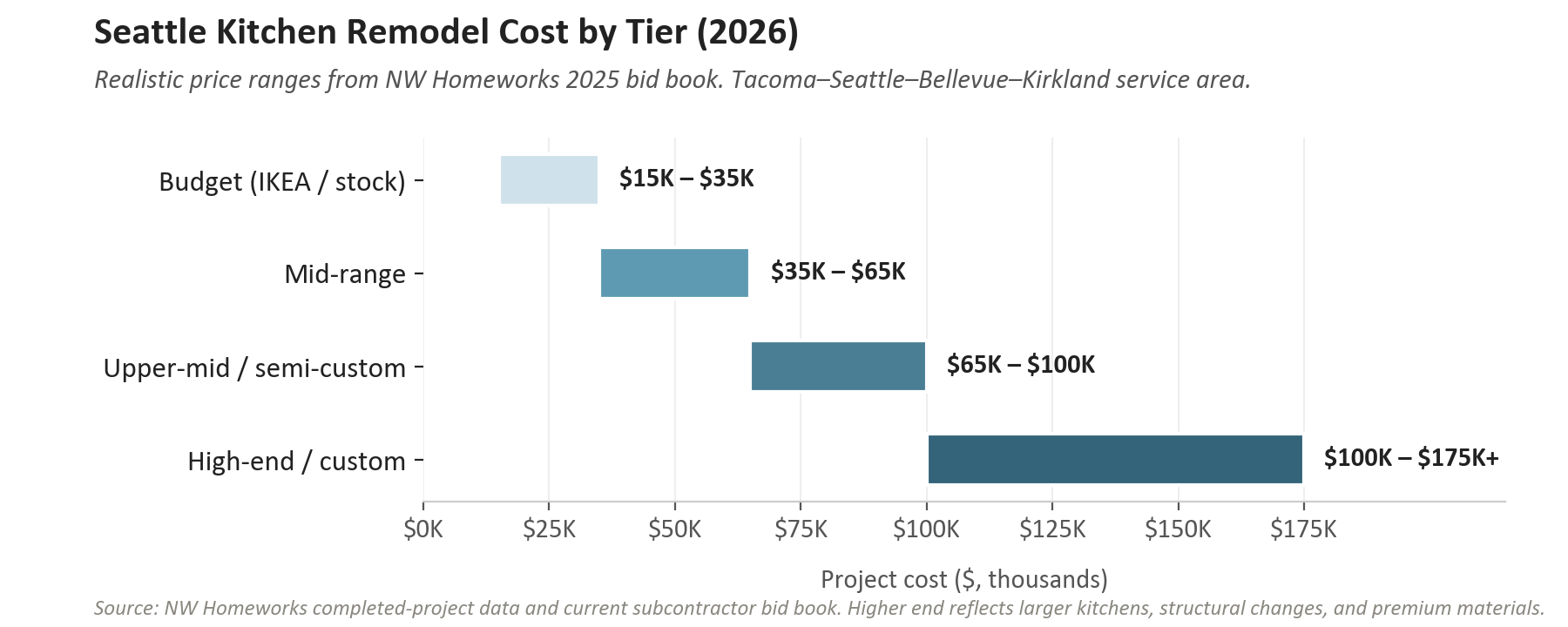
For homeowners in the greater Seattle area specifically, here’s what realistic 2026 pricing looks like, by tier. These ranges come directly from our completed-project data and our current bid book, and align with the broader breakdown in our Seattle kitchen remodel cost guide.
If you want to play with these numbers for your specific project, our free kitchen remodel cost calculator walks you through every line item with zip-code-adjusted pricing. There’s also a dedicated IKEA tier if you’re considering SEKTION cabinets with full professional installation.
The Short Version
If you’re trying to budget a kitchen remodel in 2026:
- Use a calculator that adjusts for your zip code. National averages don’t reflect what skilled labor costs in your market.
- Demand itemized line-items. A single number is a marketing pitch; a line-item breakdown is a budget.
- Skip anything that asks for your email up front. Those are lead-gen tools, not budgeting tools.
- Add a 10–20% contingency on top of whatever number you start with.
- Use the calculator to get into range — then get a real, itemized bid from a licensed contractor.
If you’re in the greater Seattle area and want to talk through your project, get in touch or call us at (253) 448-9462. Free consultations, no pressure. We serve Tacoma, Seattle, Bellevue, Kirkland, Bothell, and the greater Puget Sound area, and we’re happy to walk you through what a real, itemized estimate looks like for your specific kitchen. If you want a head start, run your numbers through our free kitchen remodel cost calculator first — you’ll come into the conversation already knowing what to expect.
Frequently Asked Questions
What is the best kitchen remodel cost calculator?
For homeowners who want a real-world budget number, the NW Homeworks Kitchen Remodel Cost Calculator is our top recommendation. It’s the only free, no-email calculator that adjusts for your zip code, breaks out every line item with labor and materials separated, includes a dedicated IKEA pricing tier, and is built and maintained by a licensed general contractor — not a marketing team. For a national-average ballpark without zip-code adjustment, the Houzz cost guide is a reasonable secondary source.
Are kitchen remodel cost calculators accurate?
The best calculators are typically within ±15–20% of a contractor’s final bid for a “normal” project. They’re less accurate when you hit project-specific issues like structural surprises, hazardous-material remediation (lead, asbestos, knob-and-tube wiring), or non-standard layouts. Calculators are a budgeting tool, not a substitute for a real bid. Always add a 10–20% contingency on top of any calculator estimate.
Which kitchen remodel calculator includes IKEA pricing?
The NW Homeworks calculator is the only free calculator we’re aware of with a dedicated IKEA pricing mode that reflects the real cost of a complete IKEA kitchen — including the trade work (plumbing, electrical, countertops, demolition, finishing) that IKEA’s own installation service does not include. Most vendor calculators only price their own cabinet brands and don’t handle IKEA at all.
What is the best free kitchen remodel calculator with no email signup?
The NW Homeworks calculator, Houzz cost guide, KraftMaid Ballpark Budget Calculator, and Reico estimator all show results without requiring an email address. We rank them in that order based on accuracy and itemization. Avoid any calculator that asks for your email before showing the result — those are lead-gen tools, not budgeting tools.
How do regional differences affect kitchen remodel costs?
Significantly. According to BLS data, construction trade wages in Seattle, San Francisco, and Boston run 25–45% above the national mean, while wages in markets like Houston and Memphis run 10–20% below it. The same kitchen remodel that costs $40,000 in a low-cost market easily runs $55,000+ in Seattle. A calculator that doesn’t ask for your zip code can’t reflect this and will be systematically wrong for anyone outside the average market.
Why do different calculators give different prices for the same kitchen?
Three reasons: (1) different underlying data sources — vendor calculators price their own products; contractor calculators price actual project bids; aggregators (Houzz, HomeAdvisor, Angi) price reported homeowner surveys, (2) different scope assumptions — some include appliances, demo, and finishing; others don’t, and (3) different regional adjustment — calculators without zip-code logic are anchored to whichever market the calculator was originally built for.
How much does a kitchen remodel cost in Seattle in 2026?
Most Seattle kitchen remodels fall between $35,000 and $100,000 for mid-range to upper-mid projects. Budget builds using IKEA or stock cabinets can come in at $15,000–$35,000. High-end and custom projects run $100,000–$175,000+. Seattle runs about 20–30% above national averages due to higher labor rates and older housing stock. Our Seattle kitchen remodel cost guide has the full breakdown.
Ready to talk through your project? Get in touch or call us at (253) 448-9462 — we work across Tacoma, Seattle, Bellevue, and the greater Puget Sound area.